Are Friday night dinner rushes forcing you to choose between your in-person guests and a constantly ringing front-desk phone? When peak order volumes collide with limited front-of-house labor capacity, food service operators face severe logistical bottlenecks.
To manage a high-volume quick-service location or a busy pizza concept, you need absolute operational efficiency to remain profitable. AI phone ordering system is the new age alternative to increase this efficiency. These cloud-based software processes multiple incoming orders simultaneously without forcing customers into long hold queues.
A recent industry study by Breez revealed that an average of 43% of restaurant phone calls go completely unanswered during peak hours. It creates massive, unrecorded holes in weekly corporate profit margins. A smart automation can instantly slash your front-of-house labor expenses by eliminating expensive hourly shifts.
This brings the quick-service restaurant owners to the core financial question: what is the actual bottom-line cost breakdown?
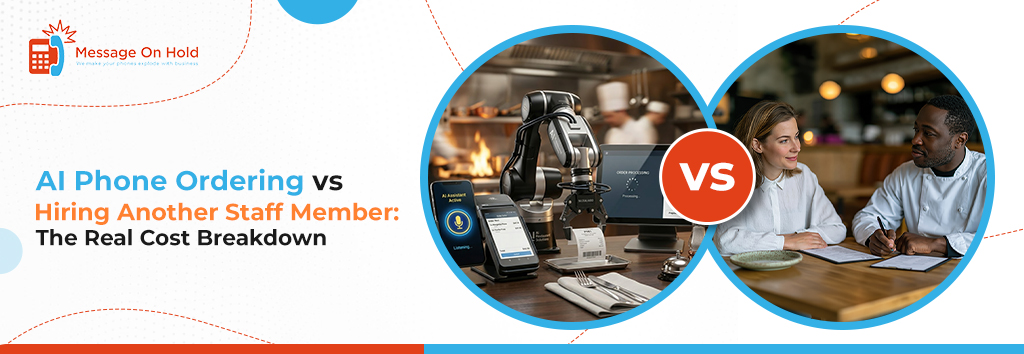
Our comprehensive analysis below elaborates on the entire financial reality of modern restaurant communication systems. We have compared AI phone ordering vs. hiring another staff member. Readers will learn the exact calculation formulas for human employee turnover, payroll taxes, and hidden front-of-house operational liabilities.
Keep reading till the end to get a comparative cost analysis.
The Cost Problems Of Concurrent Calls During Peak Hours
High-volume food establishments routinely face sudden influxes of incoming calls. Traditional phone hardware forces incoming callers into long hold queues. They also trigger immediate busy signals when lines are engaged.
Leaving your phone traffic unmanaged during critical dining windows impacts your cost margin in these ways:
- Revenue Leak
Unanswered rings represent high-intent diners who are ready to order immediately but get blocked by a busy signal. These buyers do not wait on hold and hang up instantly to purchase food from local competitors instead.
- Customer Lifetime Value (LTV) Erosion
A single bad phone experience or long hold queue permanently damages customer loyalty. Diners are easily pushed toward third-party market platforms. Such friction breaks your direct consumer relationship and erases the long-term compounding revenue of a repeat buyer.
- Front-of-House Operational Chaos
Ringing phones create immense mental stress for counter workers who are already trying to serve in-person guests face-to-face. The split focus leads to rushed order entries, severe kitchen modification mistakes, and poor hospitality standards.
- The Aggregator Tax Trap
When customers cannot get through to your shop via phone, they default to using third-party delivery apps. This shifts direct transactions into commission-heavy ecosystems, slicing 15%-30% off your net menu margins.
- Suppressed Average Order Value (AOV)
Overwhelmed counter staff naturally rush through phone conversations to clear the line. They completely forget to suggest premium add-ons.
It’s a systematic omission that cuts out profitable cross-selling opportunities like extra toppings, appetizers, and beverages.
Hidden Costs Of Human Phone Staff
As a restaurant operator, it’s common to evaluate vacancies by considering the base hourly rate on job boards. That’s a narrow focus that completely overlooks the heavy financial trailing liabilities coming with managing human labor.
When you hire additional counter staff, it brings these hidden costs onto the table:
- Base Labor Calculations
A part-time phone operator working 20 hours/week at $14/hour requires $1200 in monthly wages. The base expense persists during dead shift hours when phone call volumes drop to absolute zero.
- Payroll Taxes and Benefits
Federal and state unemployment taxes, social security contributions, and local workers’ compensation insurance premiums are something that restaurant employers face. These statutory requirements instantly add a structural 10% to 15% premium on top of hourly wages.
- The Turnover Factor
The hospitality industry faces massive annual turnover rates. Often, these rates consistently exceed 70% across North American dining markets. Replacing a single counter worker drains thousands of dollars through recruitment marketing, onboarding administration, and paid training hours.
- Scheduling Gaps and Coverage Issues
No-shows and sudden sick days force restaurant managers to scramble for coverage. As a result, it creates immediate, unexpected operational vulnerabilities. Owners must either pay overtime wages to emergency fill-ins or handle the front-desk order lines themselves.
Total Annual Cost Of Human Staff
Calculating the true cost of an employee is more than the simple face value of a bi-weekly payroll check. The table below shows the true annual cost of hiring one front-desk employee.
| Cost Category | Annual Amount |
| Base wages | $20,800 |
| Payroll taxes & insurance | $2,653 |
| Turnover costs | $1,400 |
| Coverage gaps | $1,040 |
| Total Human Cost | $25,893 |
AI Voice Ordering: The New Age Cost-Saving Solution
Deploying an AI voice assistant for restaurants completely changes how a business handles its front-of-house phone expense structure. Instead of paying an unpredictable hourly wage, you can utilize a predictable, flat monthly service software model.
Here’s the cost breakdown of implementing an AI voice ordering system:
| Cost Category | Annual Amount |
| SaaS License & Core AI Software | $1,800 |
| Menu Integration & Custom Voice Studio Setup | $450 |
| VoIP Cloud System & Lines | $1,200 |
| Wireless Failover Service & 24/7 Support | $480 |
| Total AI Cost | $3,930 |
Such a strong digital infrastructure can seamlessly handle infinite simultaneous calls. It can also ensure perfect upselling scripts on every interaction, and integrates directly with your existing cloud point-of-sale hardware.
An AI phone system at eateries completely removes variable labor liabilities. Drive down your average cost per incoming phone order to a mere fraction of traditional human overhead.
Types Of AI Phone Ordering Systems for High-Volume Restaurants
AI phone ordering systems for high-volume pizzerias or fast service spots process massive call volumes using Natural Language Processing (NLP). They can capture orders, feed, and upsell data instantly into kitchen displays – (Point Of Sale) POS system.
These are the four major types of systems:
- Conversational Voice AI
These systems use smart conversational AI to understand context, background noise, and natural speech. Customers can order exactly like they would with a human. They can ask quick questions about ingredients or make custom modifications.
- Deep POS-Integrated Order Agents
These smart systems talk directly with your current POS platform. They instantly check your live menu availability and send orders straight to your kitchen line. If a caller wants to pay, the AI texts a secure payment link to their mobile phone.
- Hybrid / Human-in-the-Loop Systems
An AI ordering system like this deflects their initial call rush instead of replacing human order-takers entirely. The AI fields the calls at first, answers basic queries, and starts the ordering process. Only during complex cases, or when the caller is frustrated, does it transfer to a live human in the restaurant.
- Enterprise Voice Frameworks
These are customizable, developer-oriented voice tech layers. Large hospitality groups with internal technical teams are now building custom conversational flows. They are integrating them into proprietary apps or adapting them for multi-lane drive-thrus.
ROI Calculator Framework
Before deploying a new communication system in your restaurant, it’s essential to conduct a clear, math-based return on investment analysis. Use this verified formula to measure your monthly financial performance of restaurant call automation:
$$\text{Net Monthly Revenue Gain} = (\text{Recovered Missed Calls} \times \text{Average Ticket Size}) – \text{AI SaaS Fee}$$
To use this framework:
- Look up your phone carrier’s monthly call logs to find your exact unanswered call volume.
- Multiply those missed opportunities by a conservative 30% conversation rate,
- Then, multiply by your average ticket size.
- Subtract the flat software subscription fee to see the immediate monthly cash flow generated by your new automation channel.
AI Phone Ordering vs. Hiring Another Staff Member: The Comparative Cost Analysis
While choosing between digital systems and human labor, you need to evaluate long-term cost variations across your operational shifts. Automated phone systems for restaurants scale gracefully during sudden volume spikes. On the other hand, human staff lines remain constrained by physical labor caps.
The AI phone ordering vs. hiring another staff member comparison below will help you make an objective financial decision:
- Upfront Capital Investment Needs
Setting up automated software involves low configuration fees to map menus. Contrarily, human employees require weeks of paid shadow training. Software reaches peak operational utility on day one without draining regular management resources.
- Variable Operational Scalability Costs
An AI phone answering system for restaurants can handle 50 concurrent calls during holiday spikes without charging extra fees. Human systems, on the other hand, require managers to schedule multiple employees, thereby rapidly inflating shift payroll expenses.
- Scripted Revenue Optimization Yields
AI-based restaurant phone answering services maintain a perfect 100% upsell attempt rate by suggesting sides and drinks on call. Human workers would routinely skip these crucial scripts during piling order lines.
- Long-Term Retention Cost Liabilities
When you deploy software applications, there’s no scope for salary raises, paid time off, or medical benefits. Such structural stability keeps your operational budgets fully predictable across multi-year fiscal planning periods.
- System Down-Time Financial Impacts
If an employee calls out, your front-desk line goes completely dark. It triggers immediate and unrecoverable revenue drops. AI phone system setup for restaurants operates with a guaranteed 99% percent cloud uptime to capture every single dollar.
Cost Benefits of an AI-Phone Ordering System
The moment you transition away from a traditional restaurant phone answering service toward an autonomous system, expect immediate advantages for your balance sheet.
Eliminating structural labor friction unlocks these cost benefits within your daily takeout and delivery operations. Each of these advantages makes automated phone ordering essential for modern restaurants:
- Immediate Front-Office Overhead Reduction
Replacing human phone management with an automated system reduces front-of-house administrative spending by thousands of dollars. You can directly reinvest these found savings into higher-quality menu ingredients.
- Total Elimination of Turnover Friction
Digital voice infrastructure never quits. They don’t file a worker claim or require a costly emergency recruitment campaign. A consistency like this eliminates the constant cycle of hiring and retraining front-desk staff.
- Mitigation of Order Entry Errors
With direct point-of-sale menu synchronization, you can ensure the system captures exact, error-free customer modifications. In this way, you can reduce remake tickets and save substantial food waste costs every month.
- Complete Capture of Hidden Demand
During intense peak hours, missed calls lead to revenue loss. An automated phone line allows your restaurant to recover this missed revenue. Every single incoming customer gets answered instantly without long delays.
- Optimization of Back-House Labor
Your kitchen staff can focus entirely on cooking food and speeding up ticket times when you remove phone management duties. The boost in restaurant operational efficiency eventually maximizes your peak output capacity.
Where A Human Receptionist Still Makes Sense?
For specific fast-service eateries, having a live staff member at your front desk remains a smart strategic choice. These are the aspects where you need human staff:
- Handling Large Event Catering: Massive office parties require custom pricing. A live staff member can negotiate flexible corporate contracts over the phone easily.
- Managing Severe Customer Complaints: Furious guests often demand immediate human empathy. A manager can resolve late delivery issues by showing emotional resonance and protecting their reputation.
- Navigating Critical Allergen Questions: Patrons with life-threatening allergies need strict ingredient verifications. AI systems cannot do that. It’s only the human staff who can cross-check recipes with kitchen cooks.
- Executing Complex Split Payments: Manual coordination is mandatory when splitting a corporate check across multiple credit cards. AI phone ordering software cannot process these complex receipts seamlessly.
The Hybrid Approach: Blending Intelligent Automation with Human Oversight
The most profitable way to run a modern restaurant is to deploy a balanced, collaborative communication architecture. The setups below combine the power of automation with the problem-solving skills of your kitchen teams:
- Smart Front-End Call Filtering
Automated systems intercept all inbound traffic on the first ring, handling routine orders and basic lookups. This keeps eighty percent of repetitive background noise away from your main service counter.
- Instant Warm Staff Transfers
When the platform detects an intricate catering request or an upset customer, it routes the call to a manager. Humans step in only for high-value interactions that require real emotional intelligence.
- Maximum Counter Staff Productivity
Your in-person staff can focus on running food and engaging face-to-face with the guests standing right in front of them. This targeted focus boosts overall table turnover rates without increasing your front-desk headcount.
- Protection Against Service Outages
If your internet connection drops, our specialized backup routing immediately protects your lines. The system shifts voice traffic over to secure cellular channels so your ordering infrastructure never goes dark.
How Message On Hold Will Help You Implement an AI Phone Ordering System?
We know that installing new technology inside a hectic kitchen can feel incredibly intimidating. That is why Message On Hold designed the onboarding process to cause zero headaches for your busy team. Our customized AI phone system setup for restaurants plugs directly into your existing operational workflow.:
Step 1: The Initial Contact
First, a hungry customer dials your regular local business phone number expecting quick, friendly service. They bypass annoying busy signals and long hold queues to order their food right away.
Step 2: The Instant Automated Answer
Immediately, our conversational assistant answers the line and takes down their entire order smoothly. The system answers questions about your specific menu while keeping a cheerful, helpful tone.
Step 3: Direct Kitchen Integration
Then, the platform captures every customized ingredient choice with complete point-of-sale precision. It routes the finalized ticket straight to your kitchen display screens or physical ticket printers.
Step 4: Text-Based Order Confirmation
Next, your customer receives an automated confirmation text detailing their exact pickup or delivery time. An instant message eliminates ordering errors and establishes solid trust before they arrive.
Step 5: A Satisfying Guest Experience
Ultimately, your kitchen prepares the meal correctly and delivers a highly satisfying dining experience. This reliable, low-stress operational flow turns one-time callers into lifetime brand advocates.
FAQs
- What Is The Average Cost Difference Between An AI Phone Ordering System And An Employee?
A full-time front-desk human employee costs over $25000 annually when factoring in payroll taxes and turnover. However, our managed cloud system operates at a predictable flat fee, cutting phone management spending by 80%
- How Does A Voice Ordering System Handle Complex Custom Customer Orders?
The conversational engine behind voice ordering technology utilizes advanced NLP matched to your POS modifier rules. For instance, if one of your customers asks for a half-pepperoni, thin-crust pizza well-done, the system logs the details accurately.
- Will Implementing An Automated System Hurt My Local Business Customer Satisfaction Scores?
No, it will not! It’s because answering calls instantly on the first ring eliminates long hold times and frustrating busy signals. For complex requests, the platform executes a smooth, instant hand-off to your live kitchen team.
- What Happens To The System If Our Restaurant Internet Goes Down During Service?
Our specialized hardware features an automated cellular backup router that activates within milliseconds of an outage. The protection keeps your voice lines, digital menu systems, and credit card terminals running safely.
Secure Your Profit Margins with the Right Communication Choice
Comparing AI phone ordering vs. hiring another staff member reveals a massive margin gap for your store. Message On Hold has designed an automated phone ordering technology to protect your peak time revenue while supporting your busy kitchen team.
Our smart system eliminates expensive staffing leaks and missed dinner orders during hectic weekend rushes. You deserve a reliable, low-stress operations model that secures high margins.
Try a 60-day free trial today to completely safeguard your own operations and stop losing high-value weekend revenue.