Managing communications across 3 stores is tough, but scaling to 30 leads to complete operational chaos. As operators add locations, relying on separate local carriers creates a fragmented disaster. A robust, multi-location restaurant phone system comes to your rescue in this regard.
It can handle full spoken orders, modifiers, payments, and send tickets directly into your point-of-sale (POS systems.)
On a busy Friday night, your pizzeria or Quick Service Restaurant (QSR) can experience exponentially multiplied missed calls. You may see your store managers juggling completely different call flows, and customer expectations for instant service going unmet.
Sounds relatable?
Well, this definitive multi-location restaurant phone system guide can solve these exact problems. A proper phone setup centralizes your entire communications stack into one unified, cloud-based dashboard and standardizes the guest experience.
Learn how to unify your communications, choose the exact features your franchise needs, and capture every single peak-hour order in the comprehensive post below.
Quick Overview:
A unified restaurant phone system centralizes communication across all franchise locations into one single cloud dashboard. It automatically routes heavy call traffic, eliminates frustrating busy signals, and integrates AI ordering. This essential technology ensures consistent service while maximizing daily revenue.
Why Multi-Location Restaurants Need a Different Phone System
Scaling profitably calls for a unified multi-site restaurant phone solution designed to handle complex, cross-location logistics without breaking a sweat.
A standard telecom setup works perfectly when you only manage a single dining room. However, the second you expand across town or into new states, that basic infrastructure becomes a massive operational liability.
- Communication Complexity Grows With Every New Location: Opening a new store means adding more hardware, new numbers, and separate vendor contracts. A standard business phone system for restaurants often breaks down when things get complex. You need architecture built for scale, not just a single storefront.
- Separate Systems Create Inconsistent Customer Experiences: Suppose when location A uses a modern restaurant IVR system and location B relies on a busy teenager, your brand trust suffers. Having consistent restaurant business phone systems across all outlets can uphold your essential brand consistency.
- Centralized Management Becomes Essential at Scale: Franchise operators cannot afford to log into different portals just to check call volume. With a unified communication system, you can monitor peak hours, missed calls, and staffing needs from one corporate dashboard.
Signs Your Multi-Location Restaurant Has Outgrown Its Phone System
It’s crucial to recognize when legacy telecom infrastructure holds back business expansion and protects overall revenue. Experiencing frequent busy tones, fragmented call analytics, and tedious manual updates proves your growing franchise needs modern technology.
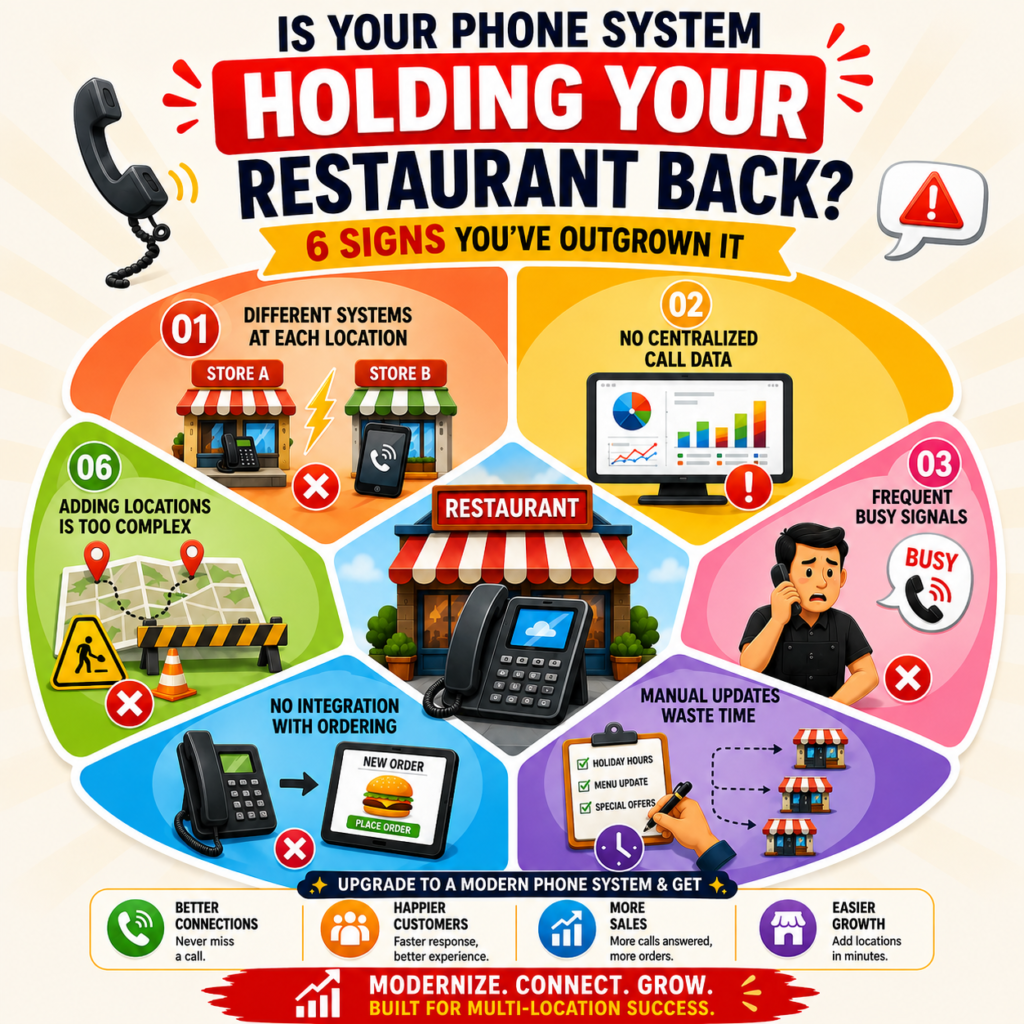
Here, we have highlighted the crucial signs that your multi-store restaurant needs an advanced phone system:
- Locations Use Different Phone Systems: If one store uses a legacy landline and another store uses a basic mobile app, your infrastructure is broken. Fragmented setups make standardization and cross-store call routing completely impossible to manage.
- Managers Cannot Access Centralized Call Data: Your leaders need to access centralized call data to work on improvements. Operating without metrics is flying blind. If you cannot instantly pull a report showing abandoned calls across all locations, your call management system is outdated.
- Customers Frequently Encounter Busy Signals: A busy signal is a direct donation to your local competitors. If your potential diners cannot get through during peak hours, your current line capacity is strangling daily revenue growth.
- Corporate Teams Cannot Update Locations Easily: Does changing Thanksgiving holiday hours require calling the phone company? Or do you need to manually dial into each store’s hardware? Your administrative workflow is wasting incredibly valuable corporate time.
- Phone Systems Cannot Integrate With Ordering Technology: If staff must listen to a caller and manually type the order into a separate tablet, your technology stack is dangerously obsolete. A standalone, disintegrated phone often creates frustrating double work.
- Adding Locations Requires Significant Technical Work: If opening a new franchise location requires trenching new copper wires, you need a modern cloud upgrade. Hiring local telecom technicians only adds unnecessary complexity and costs to your expansion process. Growth should be plug-and-play.
What Should a Multi-Location Restaurant Phone System Include?
Evaluating telecom software for a growing franchise requires looking far beyond basic features. A robust multi-location restaurant phone platform must include centralized management, intelligent routing, and advanced integrations to streamline daily operations:
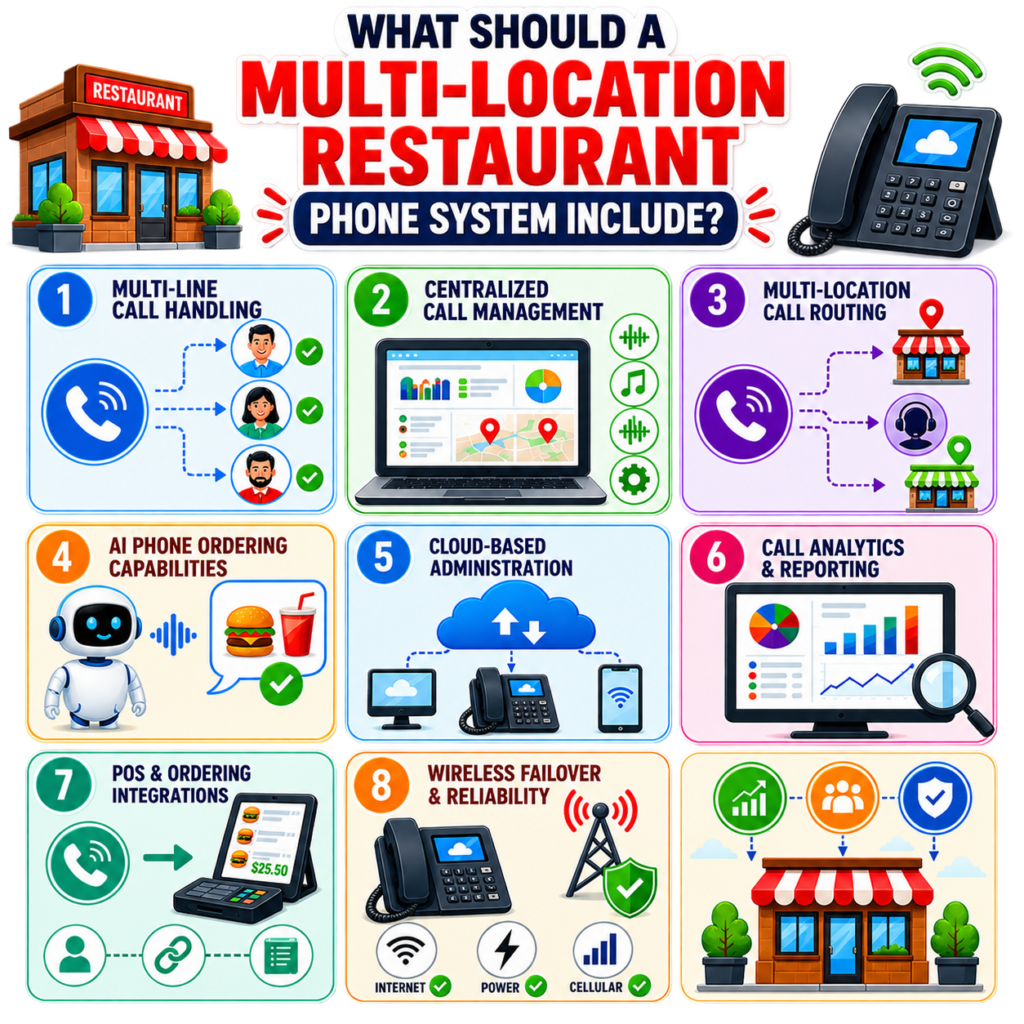
- Multi-Line Call Handling: Restaurant-focused VoIP phone systems can support multiple simultaneous calls across busy locations. Because they can efficiently route incoming calls, it never gives a hungry customer a busy signal. As a result, your revenue streams remain wide open. A solution like this is crucial when peak dinner rushes demand massive capacity.
- Centralized Call Management: Your corporate team needs total visibility. A multi-site restaurant phone solution facilitates unified call management. It allows you to update routing rules, change hold music, and monitor live call traffic. You can do these at every store from a single browser window without driving to physical sites.
- Multi-Location Call Routing: Advanced restaurant call routing prevents callers from hearing endless rings. If the downtown location is overwhelmed, smart systems can forward the call to a centralized answering hub to capture the sale.
- AI Phone Ordering Capabilities: Integrating an AI ordering system for restaurants captures every single order. Conversational voice agents can handle complex customizations, process payments, and send tickets directly to the kitchen. There is no need for any human intervention except in critical escalation scenarios.
- Cloud-Based Administration: Eliminate clunky server closets. A phone system with a cloud architecture lets IT directors deploy updates, add new phone lines, and configure menus instantly. You don’t have to dispatch expensive telecom technicians to physical store locations.
- Call Analytics and Reporting: Granular restaurant customer call management analytics should reveal exactly when you miss the most calls. You can make profitable decisions with this data and these reports. It helps you adjust kitchen prep times and front-of-house shift schedules with incredible accuracy.
- POS and Ordering Integrations: The best phone system for restaurant chains should push caller ID data and order details directly into your POS screens. In this way, your QSR can completely eliminate manual ticket entry errors. Siloed tech usually slows down service.
- Wireless Failover and Reliability: Essential phone setups must include cellular wireless failover. It can keep your VoIP phone system for restaurants and digital ordering platforms online even during internet or power outages.
How a Centralized Phone System Improves Multi-Location Operations?
When you consolidate your communication technology into one unified platform, it transforms how your franchise operates daily. Having a centralized system eliminates manual administrative tasks, standardizes guest interactions, and provides actionable data across all restaurant locations.
Take a look at how you can improve multi-location operations with this:
- Standardize Customer Communication Across Locations: A centralized approach guarantees that every caller hears the same professional greeting. You will have control over promotional messaging and brand voice. This ensures a cohesive identity across your entire franchise network.
- Reduce Administrative Work for Corporate Teams: Managing billing and tech support for a dozen different telecom providers drains administrative resources. Consolidating into one centralized phone system for restaurants means one monthly invoice, one support team, and reduced administrative overhead.
- Improve Visibility Across Restaurant Locations: As a corporate director, you can gain immediate oversight across multiple locations. Real-time dashboards highlight exactly which stores are crushing their order volume and which locations are abandoning calls. It allows for rapid operational adjustments before the weekend hits.
- Simplify New Location Setup: With a professional business phone, your new location setup becomes effortless. Instead of waiting weeks for local telecom installations, you can provision new numbers and ship pre-configured hardware. Moreover, you can also copy existing call flows to a new store in mere minutes.
- Support Consistent Brand Standards: When you deploy a unified restaurant franchise phone system, you can enforce consistent brand standards strictly. Custom on-hold marketing specials play uniformly, which ensures all customers hear about your latest seasonal promotions.
How Should You Handle Calls Across Multiple Restaurant Locations?
During those busy shifts, routing customer calls efficiently across your entire franchise network prevents abandoned orders. With the implementation of a strategic call workflow, you can ensure every hungry caller reaches the right staff member immediately:
- AI Handling for High-Volume Calls: Deploy smart automation during your absolute busiest hours. Activating an AI phone-answering system for restaurants lets artificial intelligence take over routine menu questions and order intake when the physical staff is completely swamped.
- Location-Based Call Routing: Use smart geo-routing to direct customers properly. When guests call a toll-free brand number, the system will automatically identify their area code and connect them to the nearest physical storefront instantly.
- Overflow Call Handling: Never lose a Friday night order because of overflow calls. You can set up rules that redirect unanswered calls from a busy store after three rings. These calls can route to an off-site call center or corporate office, ensuring customers reach someone.
- After-Hours and Holiday Routing: Automate your schedule variations. A dynamic phone system for multiple restaurant locations plays pre-recorded closed messages or routes catering inquiries directly to a manager’s mobile device when the store is locked.
- Department and Extension Routing: Keep kitchen staff focused on cooking. Use precise menu options to send vendor delivery questions to the back office, while routing takeout orders directly to the dedicated front counter terminal.
How to Choose the Right Phone System for Multiple Locations?
AI in restaurants is rapidly changing the way customers order. Selecting the ideal phone system for your growing restaurant chain requires careful evaluation. You must assess call volumes, technology compatibility, centralized controls, and failover reliability before investing in one.
Take a look at the crucial factors to consider:
- Evaluate Your Current Call Volume: Start by auditing your exact traffic. Identify how many calls your highest-performing store receives during a Friday rush. It helps to ensure your new restaurant phone system handles peak capacity without crashing.
- Check Compatibility With Existing Technology: Do not buy isolated software. Verify whether the new platform integrates cleanly with your current POS hardware, delivery logistics software, and customer loyalty databases. In this way, you can avoid creating new operational bottlenecks.
- Assess Centralized Management Capabilities: Test the centralized capabilities by assessing the administrator dashboard thoroughly. Ensure regional managers can easily update menus and tweak restaurant call forwarding rules without advanced IT knowledge.
- They should also monitor staff performance without requiring extensive technical training or specialized expertise.
- Consider Reliability and Failover: Check the reliability of the system by testing the backup protocols. Ask the vendors specifically about their redundancy plans and cellular failover capabilities. You need to make sure your locations stay online when local internet service providers inevitably fail.
- Compare Scalability and Total Ownership Costs: Calculate the long-term scalability by looking beyond the initial hardware price. Analyze monthly subscription fees, multi-location licensing costs, and potential savings from significantly reduced front-counter labor.
- Evaluate Provider Support and Implementation: You need a reliable partner, not just a software vendor. Choose a provider with proven experience migrating multi-unit operators. You deserve a team that offers robust onboarding support and delivers 24/7 technical troubleshooting when you need it most.
Frequently Asked Questions
- What is a multi-location restaurant phone system?
It is a unified cloud-based communications platform that connects all your franchise stores under one network, allowing corporate teams to manage routing, reporting, and settings centrally.
- Can one phone system manage multiple restaurant locations?
Yes. Modern cloud architecture allows you to control hundreds of storefronts from a single web dashboard, standardizing features like hold music and automated greetings seamlessly across the brand.
- Is VoIP suitable for multi-location restaurants?
Absolutely. A VoIP phone system for restaurants offers superior call quality, scales effortlessly without new wiring, and significantly lowers monthly telecom bills compared to traditional analog lines.
- Can restaurant phone systems integrate with POS systems?
The best platforms do. Deep integrations allow caller ID to pull up guest history instantly and push AI-generated phone orders straight to your kitchen display screens securely.
- Can AI answer calls across multiple restaurant locations?
Yes. Centralized AI agents can handle simultaneous calls across your entire footprint, taking orders, processing payments, and routing specific inquiries accurately without tying up your in-store employees.
Unify Your Multi-Location Restaurant Communications And Scale Profitably
Running a growing restaurant chain should not mean dealing with dropped calls, frustrated staff, or fragmented technology. By upgrading to a centralized phone system for multiple restaurant locations, protect your bottom line during every single dinner rush. At the same time, you can ensure brand consistency across your entire footprint.
Message On Hold specializes in transforming chaotic multi-store communications into streamlined, revenue-generating ecosystems. We provide a complete suite of solutions built exclusively for the demands of high-volume hospitality, including:
- Reliable VoIP Phone Systems
- 24/7 AI Phone Ordering
- Wireless Failover
- Online Ordering & Apps
- On-Hold Messaging
- Customer Engagement & Marketing Automation
No more losing revenue to outdated telecom limitations and disconnected hardware. Schedule a free 15-minute consultation to future-proof your multi-location restaurant operations and ensure you never miss another order.