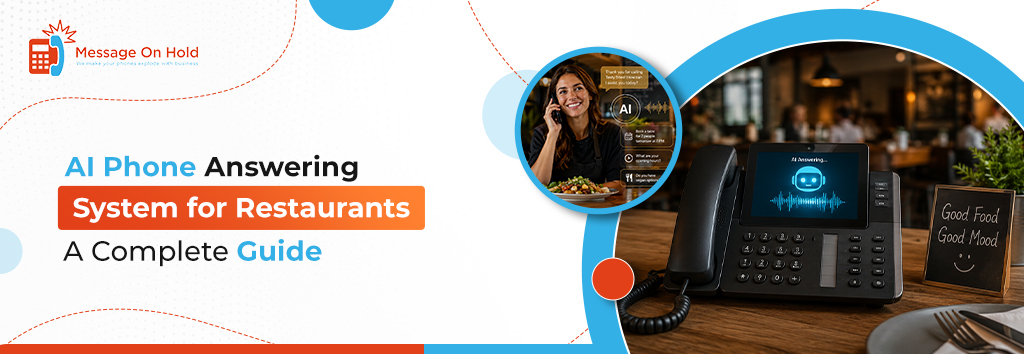
An AI phone answering system for restaurants is a voice-powered automation tool that answers incoming calls, takes orders, handles reservations, and routes inquiries automatically. This means it doesn’t require any human involvement. The system works 24/7 and responds intelligently to real customer conversations.
If your phones keep ringing during dinner service while your staff is busy with tickets, you already know the problem. Calls go unanswered, and customers who can’t get through simply hang up and order from somewhere else. In this way, every potential order gets lost.
That lost revenue can add up fast, and the frustration of the staff compounds every single shift. An AI phone answering technology can be the real game-changer here. It protects your bottom line, and meanwhile, your on-site kitchen team stays completely focused on preparing exceptional meals.
The present guide covers everything you, as a restaurant owner and operator, need to know about automated restaurant phone answering. We have elaborated on how they work, what problems they solve, which restaurants benefit most, and how to get started.
Read it before you spend another night watching orders walk out the door because nobody picked up the phone.
What Is an AI Phone Answering System for Restaurants?
An AI phone answering system is specialized new-age software. It uses natural language processing (NLP) and voice AI to handle inbound calls the way a trained employee would. The real catch is that, unlike a human, it never takes a break, falls sick, or asks to leave early on a Friday.
It greets callers, understands what they want, and takes down orders or reservations. Furthermore, the system also answers common questions and routes complex requests to a live staff member.
An AI voice assistant for restaurants listens to natural speech and responds conversationally. For instance, a customer can say, ‘I want a large pepperoni with extra cheese, no olives, and a 2Lt Coke.’ The system will capture every detail accurately, and then send the order straight to the Point Of Sale (POS)
Most of these systems also include built-in upsell logic – in the same way a well-trained employee would. When a customer places an order, the AI suggests relevant add-ons based on what they’ve ordered. That proactive upselling can increase average ticket size by 15-20 % without any additional labor.
Why Are More Restaurants Switching to AI Phone Answering Systems?
The hospitality industry across the world is facing unprecedented economic challenges. As a result, the owners need to find smarter ways to protect their bottom line. There are rising labor costs, chronic kitchen turnover, and razor-thin profit margins.
All these aspects mean that you cannot afford to waste staff hours on manual data entry. Simultaneously, diners now expect instant gratification. A single busy signal often drives them straight to a local competitor.
Hiring a dedicated phone receptionist costs restaurants thousands of dollars a year. Even then, that person can only handle one call at a time.
Implementing an AI answering service handles unlimited simultaneous calls at a fraction of the cost. For a high-volume pizza shop, that math matters enormously.
An automated phone answering service standardizes your hospitality experience. You can finally ensure every guest encounters a polite, helpful assistant even during chaotic weekend rushes. More and more restaurants are migrating to automation to decouple their revenue potential from the on-site team’s limitations.
Is an AI Phone Answering System Better Than Traditional Restaurant Phone Systems?
Gone are the days of traditional restaurant phone systems. AI technologies are now snatching the limelight. Here’s how the 4 options compare across the features that matter most to restaurant operators like you:
| Feature | Human Receptionist | IVR | VoIP phone system for restaurants | AI phone answering system for restaurants |
| Availability | Business hours only | 24/7 (limited) | 24/7 (voicemail) | 24/7 live handling |
| Order Taking | Yes | No | No | Yes + upsells |
| POS Integration | Manual entry | No | Rarely | Native integration |
| Simultaneous Calls | 1 at a time | Unlimited (basic) | Limited | Unlimited |
| Labor Cost | High ($30K+/yr) | Low | Low | Low ($99+/mo) |
| Upselling | Inconsistent | No | No | Automated + consistent |
| Natural Conversation | Yes | No (touch-tone) | No | Yes (NLP-powered) |
The comparison shows a clear pattern. AI call answering is the only option that combines 24/7 availability, real conversation handling, POS integration, and cost efficiency in one system.
How Does an AI Restaurant Phone Answering System Work?
An AI phone receptionist comes with an underlying mechanics that helps demystify how automation integrates into a kitchen ecosystem. The workflow is much simpler than it sounds. Just like a highly trained human employee, it fits directly into your existing operations:
- Answers Incoming Calls
When a customer dials your regular business number, the AI picks up instantly. It helps to eliminate hold music or voicemail. The system greets the caller with a custom, branded message and moves directly into the conversation. Moreover, an AI answering system can also handle multiple incoming calls simultaneously.
- Understands Customer Requests
This is where automated call handling separates from old-school IVR. The AI uses NLP to understand what customers actually say, including complex orders, modifications, and follow-up questions. The agent handles accents, background noise, and non-standard phrasing better than most people expect.
- Transfers Complex Calls to Staff
Sometimes one of your callers may have a request that falls outside the AI’s parameters. It might be a complaint, a catering inquiry, or an unusual customization. The system then transfers the call seamlessly to a live team member.
- Takes Food Orders and Reservations
The software captures the order details accurately and pushes directly to your POS or kitchen system. The POS integration with the phone system eliminates manual re-entry and the errors that come with it.
What Problems Can an AI Phone Answering System Solve for Restaurants?
We understand that your restaurant has to deal with a specific set of phone-related problems every shift. A distracted front-of-house staff who fails to manage your telephone lines can introduce massive hidden liabilities into your business. The AI phone answering system for restaurants addresses each of these pain points directly.
Here’s how:
- How Does AI Reduce Missed Calls?
The system answers every call instantly, regardless of how many calls come in at once. It captures the lost revenue from peak hours when staff are too busy to touch a handset.
- Can AI Improve Order Accuracy?
Your human staff often mishear order details, instructions, or updates over loud kitchen noise. On the other hand, AI pulls data directly from a digital menu file, ensuring error-free tickets.
- How Does AI Reduce Staff Interruptions?
When the phone stops pulling you off the line, the productivity across your entire operation improves. Your team can steadily focus on food, service, and the customers in front of them.
- Can AI Answer After Business Hours?
Yes, it works beyond your operating hours. An on-call answering setup runs 24/7, capturing late-night and early-morning orders that would otherwise go straight to voicemail. If your eatery is delivery-focused, that after-hours availability is pure incremental revenue.
- How Does AI Shorten Customer Wait Times?
Your guests no longer have to sit on hold listening to static music. They can move from an initial greeting to a completed order confirmation within two minutes.
What Features Should Restaurants Look for in an AI Phone Answering System?
Not all automated voice answering systems come with keeping the unique requirements of fast-service restaurants in mind. These are the specific features you should prioritize when evaluating a platform:
- 24/7 call answering: The system should handle calls at any hour without requiring staff availability.
- AI phone ordering: The platform must feature essential automated phone ordering capability with accurate capture and POS routing.
- Reservation handling: There should be an automated booking facility with confirmations sent to both the customer and staff.
- Call routing: The software should easily distinguish between a routine takeout order, a vendor delivery question, and an urgent customer service escalation.
- Multi-location support: If your brand is a growing regional one, your conversational platform must manage multiple stores through a centralized dashboard.
- POS integrations: There should be native compatibility with major POS platforms so that orders flow in without manual entry.
- Customer Relationship Management (CRM) integrations: The system should sync with your CRM database to log guest preferences and ordering habits.
- Analytics: An executive dashboard must display call volume, conversion rates, and upsell performance data. All these help in making informed decisions.
- Call recording: There should be a facility for recording calls for quality review, dispute resolution, and training purposes.
- Multilingual support: Look for systems that can serve customers in their preferred language and vocabulary. It’s critical for the current diverse markets.
Which Restaurants Benefit Most From Restaurant Call Automation?
From an automated phone answering service, every restaurant operating with a high percentage of off-premise sales sees immediate utility. However, these specific operational concepts can provide massive structural advantages:
- Pizza restaurants: In pizza points, phone ordering remains dominant. High call volume, complex modifications, and delivery logistics make AI ordering services essential.
- Quick-service Restaurants (QSRs): Speed is non-negotiable in this regard. An AI phone receptionist handles ordering efficiently in a way that your staff can stay focused on other tasks.
- Cafes: Pre-orders and reservation requests during morning rushes at cafes benefit from instant automated handling.
- Fine dining: AI call answering can handle reservation management, special accommodations, and event inquiries singlehandedly.
- Delivery restaurants: Even when there’s no live staff, 24/7 call coverage captures late-night orders and keeps delivery volume steady.
- Ghost kitchens: With no dine-in staff, ghost kitchens rely entirely on digital and phone ordering channels. AI handles the phone side flawlessly.
How Much Does an AI Phone Answering System Cost for Restaurants?
Investing in a business phone answering system with AI capabilities varies from one restaurant to another. The difference in cost structure entirely depends on features, volume, and the provider’s restaurant specialization.
We’ve presented a realistic pricing breakdown here:
- Monthly subscriptions
Entry-level packages typically start around $99/month. The amount may scale based on your call volume, number of locations, and feature depth.
- Setup costs
Many providers charge a one-time setup or onboarding fee for a next-level POS integration, voice configuration, and workflow mapping. However, there are some partners who waive this for new customers.
- Per-call or per-order pricing
Rather than a flat monthly fee, certain platforms charge per transaction. It’s only relevant if your restaurant has lower-volume operations.
- ROI
If your restaurant misses 20 calls per week at an average order value of $35, it loses roughly $36,400 in annual revenue. At $99 to $300 per month, you’ll see the system paying for itself within weeks.
- Cost savings
When you eliminate a phone reception role from your eatery, you can save $25,000 to $45,000 annually. An AI system can work every single hour without demanding overtime pay, sick leave, or expensive worker benefits.
Is An Automated Voice Answering System Worth The Investment?
For most restaurants, the answer is yes, an automated answering service is worth your investment.
The recovered revenue from missed calls immediately hits your bottom line. The change becomes visible in your restaurant’s financial performance. A significantly reduced phone duty frees your staff to focus on food and service. Your regular guests stay loyal when they never hit a busy signal during a Friday rush or holiday weekend.
Nevertheless, the real advantage comes from blending humans and AI together. The cloud-based voice assistant can handle volume, accuracy, and after-hours coverage efficiently. On the other hand, let your team handle judgment calls, complaints, and relationship-building.
Neither replaces the other, and on top of that, they work better in combination. That balance is where operational advantage actually lives.
How Can Restaurants Successfully Implement an AI Phone Answering System?
Transitioning your restaurant to an automated call workflow requires an organized, step-by-step approach to protect daily operations. However, the implementation can go smoothly when your team treats it as a workflow project.
Follow this structured approach below to reduce friction and experience full performance faster.
- Assess call volume
Pull data on your busiest hours, average call duration, and how many calls go unanswered. This baseline informs your configuration.
- Map customer journeys
Identify the most common call types – whether it’s ordering, reservations, hours, directions, or complaints. You need to configure the AI for your specific callers in a curated way.
- Configure AI workflows
Get in touch with your provider to set up call routing, upsell prompts, fallback logic, and POS integration. This is where you should rely on a provider who carries restaurant-specific expertise. It will pay off.
- Train staff
Your team should understand how the system works, what calls it handles, and when live transfers come through. Active co-operation from your staff will speed adoption and reduce the cloud of confusion.
- Monitor analytics
During the first month, review your software dashboard on a daily basis. It will help you audit order completion rates and customer drop-off points. We suggest that you pay close attention to any unique phrasing or regional slang that the voice engine may need to learn.
- Continuously optimize
Whenever the pricing of any item changes, ingredients shift, or seasonal items launch, update your digital menu files instantly. You also need to refine your automated upselling scripts consistently. The script should be based on the data on which appetizers or desserts convert best over the phone.
What Mistakes Should Restaurants Avoid When Choosing an AI Phone Answering System?
Many restaurant owners waste thousands of dollars by rushing into software agreements. What they miss out on is vetting the underlying technology architecture.
Avoid these common industry missteps to protect your brand reputation and preserve guest satisfaction.
- Are You Settling for Generic, One-Size-Fits-All AI?
Avoid generic AI that fails to understand complex menu modifications.
- Are You Bypassing Your Actual Kitchen Workflows?
Do not ignore restaurant workflows that sync directly with kitchen staff.
- Does the Platform Lack a Robust Live Transfer Option?
Never skip live transfer options for customers needing real human help.
- Are You Accepting Choppy, Low-Quality Voice Streams?
Reject poor call quality that frustrates hungry guests with robotic audio.
- Is the Tech Vendor Offering Weak, Slow Support?
Avoid weak technical support that disappears during busy weekend dinner rushes.
- Did You Overlook Hardware and Internet Failover Protection?
Never buy systems lacking failover protection against local internet outages.
- Will You Be Stranded with Limited POS and Software Integrations?
Avoid creating modern data silos that force your front-of-house staff to manually retype phone orders into your terminal.
How Do You Choose the Right AI Phone Answering Provider for Your Restaurant?
The provider decision matters as much as the technology. When selecting a communication vendor, you need to look past flashy software demonstrations. Even a strong platform in the wrong hands delivers a mediocre result.
Evaluate the providers against these criteria:
- Restaurant expertise
Generic automated call handling tools trained on generic business use cases often miss restaurant-specific nuances. Look for providers who dedicate themselves to serve high-volume pizzerias, fast-casual joints, and quick-service operations.
- AI capabilities
Look for natural language processing that handles real conversation. It’s proven that scripted menus don’t optimize conversions. It’s essential to test the system before you buy.
- VoIP infrastructure
The underlying phone infrastructure matters significantly. A provider offering a full VOIP phone system for restaurants, alongside AI, means one vendor manages your entire phone stack.
- Support
Unlike a corporate office, restaurant hours are not 9 to 5. Your provider’s support team should be available even in the evenings and weekends. These are the hours when your operation is busiest.
- Installation and training
Ask the team what the onboarding process looks like. A provider that handles full POS integration and trains your team removes a significant burden from your plate.
- Scalability:
Assess whether the system can grow with you. Multi-location operators need centralized management and consistent performance across every store.
- Security
The AI system that you are installing needs to handle customer order data and payment information properly. As a result, it’s crucial to confirm the provider’s data security practices and compliance standards.
- Customer reviews
Real restaurant operators who’ve used the system for 6 to 2 months will tell you what the sales pitch won’t. Look for testimonials specifically from your segment.
Message On Hold checks every one of these criteria. With over 30 years of serving pizza chains and QSRs, our platform stands on restaurant operations from the ground up. We haven’t adapted from a generic call center tool.
Our all-in-one approach covers AI ordering, a VOIP phone system for restaurants, wireless failover, and delivery logistics under a single roof. Get a free 60-day trial that removes the risk from the first step.
Frequently Asked Questions
1. Can AI answer restaurant phone calls without human staff?
Yes, a restaurant answering service operates completely independently to answer calls. It can efficiently handle basic queries and process tasks around the clock without demanding human supervision.
2. Can AI take restaurant orders over the phone?
Yes, a conversational AI phone ordering system reads your live menu and immediately processes complex ingredient modifications. Furthermore, it can collect credit card payments securely and send tickets straight to your kitchen printers.
3. How much does an AI phone answering system cost?
Most restaurants pay a base monthly subscription fee ranging between $150 and $499 per location. Besides this, there’s an initial one-time onboarding setup cost for menu integration.
4. Can AI answer calls after business hours?
Yes, the cloud-based software remains fully active 24/7. Your restaurant can therefore log early-morning catering requests and late-night guest inquiries while your physical doors are closed.
5. Will customers know they’re speaking with AI?
Modern conversational voice engines sound incredibly natural and human. However, you can configure the system to inform guests transparently that they are speaking with a digital assistant. In this way, your eatery can ensure clear communication.
Choose Message On Hold And Implement The Ideal AI Phone Answering System In Your Restaurant
Upgrading to an automated phone system is no longer a luxury reserved for massive global fast-food franchises. Rising labor costs and leaking takeout revenue are taking a toll on independent operators and growing regional brands. For these businesses, it represents an essential structural shield.
Implementing a dedicated AI phone answering system ensures that your business answers every customer call on the first ring. At Message On Hold, our advanced automation minimizes staff stress from the baseline. We help you secure consistent profit margins across every shift. Your frontline hospitality staff can focus entirely on crafting premium food and delivering memorable on-site guest experiences.
Instead of settling for a generic corporate phone line that drops revenue, deploy our restaurant-specific communication ecosystem. Connect with our specialized team at Message On Hold today. Discover how our tailored, hospitality-engineered AI and cloud VOIP solutions can protect your margins and optimize your kitchen workflow.