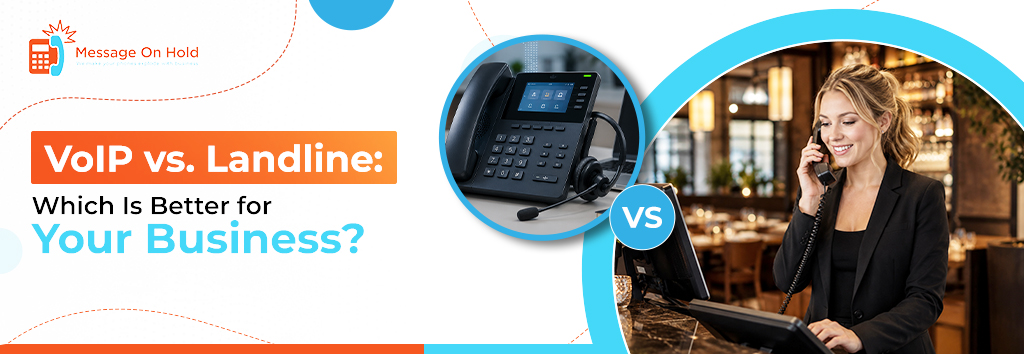
Reliable communication is the backbone of every successful restaurant today. The phone system you choose directly shapes customer experience, daily operations, and long-term growth.
For years, food-service businesses depended on traditional desk phones and landline systems for everyday communication. Today, that landscape is changing as more organizations are adopting VoIP phone systems to support greater flexibility, remote work, and evolving operational needs across industries.
Are you looking for a reliable business phone system and not sure which one to choose—traditional or VoIP?
This guide compares VoIP vs. landline in detail. Read the blog till the end and confidently choose the system that fits your business needs.
VoIP vs. Landline – Core Differences At A Glance
| Feature | VoIP | Landline |
| Technology | Transmits voice over the internet as digital data packets. | Transmits voice through copper wire or fiber-optic cables. |
| Cost | Lower monthly cost, scales affordably with added lines. | Higher setup and monthly fees. Add-ons cost extra. |
| Scalability | Add lines or locations instantly through the dashboard. | Scaling requires physical infrastructure and technician visits |
| Features | Advanced features such as call routing, analytics, CRM integration, and AI. | Basic features like caller ID, call waiting, forwarding, and three-way calling |
| Reliability | Cellular backup systems guarantee continuous uptime. | Physical copper wires survive internet outages. |
Understanding VoIP and Traditional Landlines
Before comparing VoIP and traditional landlines, it helps to understand what each system actually is and how it works. Both handle voice calls. Nonetheless, their underlying technology, cost structure, and capability sets are fundamentally different from each other.
What Is a Traditional Landline?
A traditional landline routes your daily phone calls through physical copper wires hanging from utility poles. These aging analog networks push your live voice through continuous electrical pulses toward physical locations.
Local telecom providers must install heavy on-site routing hardware to connect your restaurant building directly. It’s a legacy infrastructure that delivers basic voice calling without requiring any modern broadband internet connectivity today.
What Is VoIP?
When you ask what VoIP is, understand that this technology routes your calls across fast internet networks seamlessly.
VoIP (Voice over Internet Protocol) transforms your daily traditional restaurant calls into digital data packets today. This modern internet technology routes your live audio traffic across robust high-speed broadband fiber connections.
You get to bypass outdated physical copper wire infrastructure and unlock advanced automated customer communication network features. Upgrading to these flexible cloud platforms reduces your monthly telecom expenses and boosts workforce mobility.
Landline vs VoIP for Restaurant Businesses: Key Differences
Comparing a landline and VoIP phone highlights several critical operational distinctions for modern businesses. Your choice dictates how your workforce handles essential daily customer telephone communication tasks regularly.
Review these 5 fundamental system differences before finalizing your communication upgrades today:
- Connection Infrastructure
Internet telephony requires broadband connections to route calls through secure digital servers every day. Legacy networks depend entirely on physical copper cables connecting your building to regional grids.
Digital lines, on the other hand, bypass local utility outages by utilizing robust global cloud server hosting networks. The core difference impacts overall system reliability significantly.
- Feature Availability
Evaluating landline vs VoIP for business reveals stark contrasts regarding modern caller management tools. Cloud platforms offer advanced artificial intelligence integrations and automated text messaging capabilities quite easily. Digital routing naturally supports custom interactive menus perfectly.
Conversely, analog phones provide basic caller identification and simple voicemail recording functions without smart features.
- Scalability and Growth
Adding new extensions to digital systems requires only a few simple mouse clicks online. VoIP technology adapts instantly whenever you open new restaurant locations or hire seasonal staff. You always avoid paying costly physical installation fees.
Copper wire networks demand physical technician visits to install additional hardware lines during expansions.
- Cost Structures
Standard telephone providers frequently bill businesses per minute and add complex hardware maintenance service fees.
However, cloud solutions eliminate expensive on-site server hardware purchases that drain your crucial startup capital. Such predictable monthly pricing helps owners manage budgets.
- Location Independence
With VoIP, your staff can answer digital business calls using their personal smartphones from anywhere globally today. Cloud routing dynamically routes incoming calls always.
Ordinary phones physically tether your staff members to their specific wooden desk environments. The incredible mobility ensures you never miss important customer inquiries during busy travel days.
Pros and Cons of VoIP for Modern Restaurant Businesses
VoIP has become the default phone infrastructure for growth-focused businesses, and the reasons go beyond cost alone. From scalability to feature depth, VoIP is the best option for operators who need their phone system to do more than just ring.
Here is a complete breakdown of the pros and cons for a restaurant VoIP system:
| Pros | Cons |
| Lower monthly cost with no per-line hardware fees. | Requires a stable, high-bandwidth internet connection. |
| Scales instantly across multiple locations or remote teams. | Call quality can drop during internet outages or congestion. |
| Advanced features include analytics, CRM integration, and call routing. | 911 emergency routing requires E911 configuration by provider. |
| Works from any device with a reliable internet connection. | Setup requires onboarding and staff familiarization. |
| Supports AI ordering, on-hold messaging, and IVR natively. | Security depends on provider encryption and network hygiene. |
Pros and Cons of Landline for Quick-Service Restaurants
Landlines still hold a real place in specific restaurant business contexts. For areas with unreliable internet, or for businesses that prioritize simplicity and physical call security, it makes sense.
In this regard, the traditional system still delivers on its core promise of consistent, dependable voice communication.
Take a look at the pros and cons list below:
| Pros | Cons |
| Highly reliable and works without an internet connection. | Higher monthly costs, including add-ons, increase fees significantly |
| Consistent call quality unaffected by bandwidth fluctuations. | Limited to basic features such as caller ID, waiting, forwarding. |
| It’s very simple to operate. There is no software or training required. | Cannot scale without physical installation at each location. |
| Automatic 911 routing tied to a fixed geographic address. | No integration with Point-Of-Sale (POS), CRM, or ordering platforms. |
| Strong data security through closed, physical circuits. | Increasingly discontinued by major telecom carriers nationwide. |
When a Traditional Landline Still Makes Sense?
A traditional landline still makes practical sense in very specific and limited operational circumstances. Restaurants in remote areas facing unreliable broadband internet connections require the absolute stability of physical wires.
Traditional analog networks deliver consistent call quality when local internet speeds constantly fluctuate today. Businesses managing strict data security regulations frequently prefer utilizing strictly closed-circuit physical telephone networks.
Moreover, small operations experiencing extremely low call volumes might simply require basic analog phone hardware. These legacy systems cover basic communication needs without adding complicated monthly digital software subscriptions.
Frequent local internet outages in rural areas can immediately destroy your ability to serve hungry paying customers completely. A physical landline provides crucial offline independence during severe regional electrical grid power failures. You must weigh this reliability carefully against the incredible features modern VoIP delivers.
Why Restaurants Are Choosing VoIP Over Landlines?
Fast-paced food service operations like your business require highly adaptable technology that traditional phone lines simply cannot provide anymore. Switching to modern digital networks like VoIP solves everyday frustrating communication challenges
Simultaneously, it reduces monthly telecom expenses. Consider why so many modern restaurants actively replace their aging copper wires with flexible internet-based platforms today:
- Handling High Call Volumes
VoIP technology automatically routes incoming calls seamlessly when your front lobby gets extremely busy. This smart automation ensures your hungry customers never hear busy signals during your chaotic Friday night dinner rushes.
- Cutting Monthly Operational Costs
Digital systems eliminate those expensive physical hardware maintenance contracts required by traditional local utility companies. You can enjoy predictable flat-rate monthly billing that includes unlimited domestic calling without surprise extra charges.
- Enhancing Workforce Mobility
Managers can easily answer crucial vendor calls using their personal smartphones from absolutely anywhere globally. Such location independence keeps your leadership team accessible even when they step away from the building.
- Integrating With Essential Software
VoIP seamlessly connects directly into your existing modern POS system without any hassle. A smart connection like this automatically displays returning customer details before your staff even answers the ringing phone.
- Scaling Up Without Friction
Opening a brand new restaurant location requires zero physical copper wire installation appointments from slow utility technicians. You can simply add new digital phone extensions online instantly to support your rapid business expansion completely.
How to Choose the Right Phone System for Your Business?
VoIP vs landline – the right choice depends on where your business is today and where it needs to go. Evaluate these 5 crucial factors before committing to either system.
- Assess your internet reliability
VoIP requires consistent, high-bandwidth connectivity to deliver clear, uninterrupted call quality. Audit your current connection speeds and outage frequency before making the switch to any internet-based phone platform.
- Calculate your total cost of ownership
Compare not just monthly fees but equipment, installation, and feature add-on costs across both options. Most businesses favor VoIP for small businesses by a significant margin over 12 months.
- Map the features your operation actually needs
Do you need a steady POS integration, AI ordering, on-hold messaging, or multi-location call routing? Only a VoIP platform delivers those capabilities natively without expensive third-party add-ons.
- Consider your growth trajectory
Opening a second location or adding staff means adding lines. However, VoIP scales with a few clicks and no hardware visits. A landline requires a new physical installation at every expansion point, adding cost and delay.
- Evaluate vendor support and uptime guarantees
Look for a trustworthy and efficient restaurant-specific VoIP provider offering 24/7 support, wireless failover options, and guaranteed uptime SLAs. A provider that goes quiet during a Friday dinner rush is not a partner worth keeping.
Signs It’s Time to Upgrade Your Business Phone System
Most fast service restaurants and pizzerias wait too long to upgrade their phone infrastructure. Meanwhile, they struggle with missed calls, outdated systems, and costly communication inefficiencies daily.
Don’t be one like them. These 5 signals tell you the current system is already costing you customers and revenue every shift.
- Callers regularly get busy signals during peak hours
A system that can’t handle simultaneous calls during your busiest window is actively turning customers away. It’s the most direct sign that your current setup has already outgrown your needs.
- Your phone system doesn’t integrate with your POS or CRM
Disconnected systems force manual data entry, create order errors, and eliminate any chance of capturing caller analytics. Modern operations need their phone to talk to the rest of their technology stack. A VoIP phone system does exactly that.
- Staff spend significant time answering non-order calls
If your team fields repeated calls about hours, parking, or directions, an automated system like VoIP can handle those calls entirely. Freeing your staff from routine inquiries is a direct productivity and labor cost improvement.
- You have opened or plan to open additional locations
Managing separate landline accounts across multiple locations is expensive and operationally fragmented. A single phone system like a VoIP platform manages every location centrally, with consistent caller experiences across the board.
- Your provider has announced landline discontinuation in your area
Major US telecom carriers are actively retiring copper landline infrastructure across the country. If your carrier has flagged your line for sunset, planning your VoIP migration now prevents a forced, rushed transition later.
FAQs
- What is the difference between VoIP and a traditional landline?
A landline transmits voice through physical copper or fiber cables. VoIP converts your voice into digital data and sends it over the internet. VoIP costs less, scales faster, and supports advanced features that traditional landlines simply cannot deliver regardless of plan or pricing.
- Is VoIP better than a landline for restaurants?
For most quick-service restaurants, yes. VoIP platforms handle simultaneous calls, integrate with POS systems, support AI ordering and on-hold messaging, and provide call analytics. Landlines offer none of those capabilities.
The landline vs VoIP for business is especially one-sided for high-volume, delivery-focused operations.
- Can I keep my business phone number when switching to VoIP?
Yes. Most VoIP providers offer number porting, which transfers your existing business number to the new system. The process typically takes a few business days. Moreover, it does not require you to notify customers or change any printed materials, signage, or online listings.
- Does VoIP require an internet connection?
Yes. VoIP transmits calls over the internet. Hence, a reliable, high-bandwidth connection is essential for consistent call quality. Restaurant-grade VoIP providers often include wireless failover as a backup option. It ensures your phones stay online even when your primary internet connection goes down.
- How do I know if it’s time to replace my landline?
Frequent busy signals, staff time lost to routine calls, or no POS integration notice are all clear signals. If your current system can’t scale, connect to your technology stack, or handle your call volume, the upgrade is necessary.
Make the Phone Decision That Actually Serves Your Business
Both landlines and VoIP have their place. For restaurants that depend on high-volume, accurate, round-the-clock phone communication, VoIP vs landline comparisons point clearly in one direction. The flexibility, scalability, and advanced features of a modern VoIP system make it the stronger long-term investment.
Before making a final decision, honestly assess your current communication challenges. Ask where calls are being dropped, where staff time is being wasted, and where your phone system is creating friction instead of removing it.
Then map those gaps against what your growth plan requires over the next two to three years. Your phone infrastructure should support where you’re going, not anchor you to where you’ve been.
Message On Hold delivers restaurant-grade VoIP solutions for over 30 years. Our system includes built-in IVR technology, professional multi-line call handling, cloud-based management, custom call-routing, and wireless failover protection. We manage all these through a single platform built specifically for how restaurants operate.
If your current phone setup is holding your business back, the next step is a straightforward one. Partner with us and upgrade to our exceptional VoIP phone system today! Enjoy lower operating costs, greater scalability, and improved customer communication.