Friday dinner rushes can put your whole pizza shop team under pressure. All the phones keep ringing while your employees prepare orders and serve customers. Every unanswered call can mean a missed ordering opportunity.
What if every caller received a quick, helpful response, even during your busiest hours?
An AI ordering system can answer eligible calls when your employees are super busy. It can record orders, suggest relevant extras, and send details to compatible restaurant technology. These features matter to pizza shops and quick service restaurants (QSRs). Phone demand often rises during peak hours.
Are you wondering whether AI-ordering technologies fit your restaurant? Knowing the benefits helps you decide correctly. This article covers the key benefits and practical considerations of automated ordering technologies for fast-service restaurants. You can also identify the features that matter most to your customers and daily operations.
Keep reading!
Quick Answer: AI ordering can capture eligible calls around the clock and reduce manual entry errors. It can also support upselling, reduce staff pressure, and improve order flow. The results may vary from one system to another and depends on configuration, integration quality, and customer acceptance.
What Is an AI Ordering System for Restaurants?
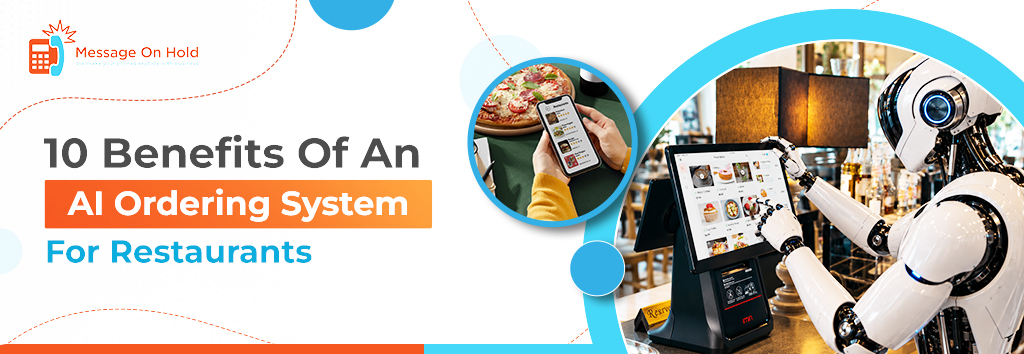
An AI ordering system for restaurants can support customers across phone, drive-through, kiosk, web, app, and SMS channels. It can answer questions, capture detailed orders, recommend suitable extras, and pass confirmed tickets to restaurant systems.
Some systems can also support payments, loyalty rewards, order updates, and performance reporting.
Core Components and Features
- Voice and Phone AI Agents: Answer incoming calls around the clock, manage rush hour demand, understand natural speech and accents, and process toppings, modifiers, and half and half requests.
- Analytics and Business Insights: Can show call demand, order patterns, sales performance, and service issues. In this way, you can review daily operations.
- Order Tracking and Notifications: Shares updates about preparation, collection, delivery, and expected wait times.
- Payment Processing and Loyalty: Supports secure checkout, digital wallets, saved cards, and automatic loyalty rewards when available.
- POS and Kitchen Integration: Sends confirmed tickets directly to the point-of-sale (POS) system, printer, or kitchen display system without manual re-entry.
- AI Recommendation and Upselling Engines: Suggest relevant add-ons, meal combinations, or drinks using preferences, dietary needs, and order history.
- Conversational Chatbots and Web Assistants: Let customers browse menus, ask about ingredients or allergens, and choose suitable options through websites, apps, or SMS.
- Drive-Thru and Kiosk AI: Use voice tools or self-service kiosks to shorten queues and reduce front counter pressure.
10 Benefits of an AI Ordering System for Restaurants
Every restaurant has busy periods when a few extra minutes can affect the whole shift. Missed calls, rushed staff, and unclear tickets can create problems for both your team and customers.
The right ordering support can take pressure off your employees and keep the service moving. Here are the 10 benefits to consider before choosing a solution.
1. Never Miss an Order With 24/7 Availability
An AI restaurant ordering solution can answer eligible calls outside normal staffing hours. It can also manage overflow when employees cannot respond promptly. This availability matters when your customers call during busy evenings or after regular business hours.
Imagine a situation like this: a customer is calling your pizza shop on Friday evening. Your employees are packing delivery orders while another team member serves customers. The system can answer the call and start recording the order.
This can protect orders that might otherwise go unanswered. Still, answering calls does not guarantee completed sales. Your system needs enough call capacity and accurate menu information.
Key Benefits
- Capture After-Hours Orders.
- Handle Peak Call Volumes.
- Reduce Unanswered Customer Calls.
2. Reduce Order Errors and Improve Accuracy
AI order taking can capture menu selections consistently and reduce rushed manual transcription. That matters when customers request several customizations during one short conversation.
For example, a customer may order two pizzas with different toppings. The system can record each choice and confirm key details. Clear order records can reduce confusion when kitchen staff receive the ticket.
However, accuracy still depends on menu setup and speech recognition. You need to test how the system handles substitutions, unavailable items, and unusual requests. Your staff should also know how to fix errors before preparation begins.
Key Benefits
- Record Menu Customizations Clearly.
- Confirm Important Order Details.
- Reduce Manual Entry Mistakes.
3. Increase Average Order Value Through Relevant Upselling
An AI-powered ordering system can suggest relevant extras during the ordering conversation. For pizza shops, those offers might include garlic bread, drinks, desserts, or additional toppings.
Your employees may forget to suggest extras during a busy shift. Automated prompts can present configured offers consistently. Your customers can accept useful suggestions without another conversation with staff.
Nevertheless, higher average order value depends on customer acceptance and offer relevance. Too many prompts or irrelevant offers may frustrate callers or slow ordering. It’s essential to review sales data to find which offers work best for your menu.
Key Benefits
- Suggest Relevant Menu Extras.
- Promote Suitable Meal Combinations.
- Increase Potential Basket Value.
4. Gain Valuable Data and Operational Insights
A restaurant ordering software with suitable reporting can reveal patterns in your phone demand. Depending on the provider you choose, the reports may include call volumes, completed orders, restaurant call abandonments, and transfers.
Your reports might show that calls peak earlier on Fridays. You could use that pattern to review staffing or promotional schedules. Furthermore, these data may reveal recurring order issues that need immediate attention.
Key Benefits
- Identify Peak Calling Periods.
- Review Completed Order Trends.
- Spot Recurring Ordering Problems.
5. Deliver Faster Service and Reduce Waiting Times
AI voice ordering can reduce the time customers usually spend waiting for an employee to answer. It can start eligible ordering conversations while your team serves other customers.
Several people might call during a weekend dinner rush. An automated response can help customers start ordering without waiting for another employee. AI drive-thru ordering may also reduce delays caused by manual order entries.
Key Benefits
- Shorten Initial Call Waiting.
- Handle Calls During Rushes.
- Reduce Delays From Re-entry.
Remember: Faster call answering does not automatically guarantee quicker food preparation. Kitchen capacity and delivery availability still affect fulfillment times. Track call response and preparation times to find where delays occur.
6. Improve the Customer Ordering Experience
Conversational AI for restaurants can provide a consistent process for routine ordering requests. Clear prompts and order confirmations help customers understand what they selected.
Think about a returning customer who wants a familiar pizza for collection. The system can capture the order and confirm its details. Customers may value this convenience when employees handle other tasks.
Ultimately, the experience depends on how clearly the system responds. Customers need simple instructions and an easy way to reach staff. You need to test common questions and filter out unusual requests before launch.
Key Benefits
- Provide Clear Ordering Prompts.
- Confirm Selections Before Submission.
- Offer Human Support Options.
7. Connect Orders With POS and Kitchen Systems
AI phone ordering can send confirmed orders into a compatible and integrated POS workflow. In this way, you can reduce duplicate entry when the integration supports your restaurant’s menu and ordering process.
For instance, a customer orders a pizza with several personalizations. The system records each selection and sends it to the supported POS. After that, your kitchen staff can then work from the order ticket.
Key Benefits
- Send Orders Into POS.
- Reduce Duplicate Order Entry.
- Support Clear Kitchen Tickets.
8. Scale Ordering Across Multiple Locations
An AI ordering system setup can support consistent phone handling across multiple restaurant locations. Your central management may simplify shared settings while allowing local differences.
A growing pizza franchise might use common ordering procedures across several branches. Each location can keep its own menu, opening hours, prices, and promotions. Such an approach supports consistency but doesn’t make every store operate identically.
However, you should review each location’s configuration and test local workflows. As demand grows, monitor call capacity and escalation procedures. A setup that works for one store may need changes across a larger group.
Key Benefits
- Maintain Consistent Ordering Procedures.
- Support Location-Specific Menus.
- Manage Growth Across Branches.
9. Lower Labor Costs and Reduce Staff Pressure
An automated ordering system can reduce the time employees spend answering routine calls. Your team can give more attention to food preparation and in-store service.
Consider a small pizza shop during its evening rush. Employees prepare orders and also coordinate collections and deliveries at the same time. Automated phone handling can reduce interruptions and help staff manage their existing responsibilities.
A lighter workload does not automatically mean lower payroll costs. Subscription fees, setup expenses, and integration charges affect the financial outcome. Before investing in technology, we suggest comparing those costs with changes in call handling and completed orders.
Key Benefits
- Reduce Repetitive Phone Tasks.
- Support Existing Restaurant Staff.
- Improve Shift Workload Distribution.
10. Encourage Customer Loyalty and Retention
One of the most valuable benefits of AI in restaurants is its potential to support customer retention after connecting with suitable engagement tools. Convenient ordering may encourage customers to return out of loyalty when the overall experience meets expectations.
A restaurant may use approved customer records for relevant reorder reminders. A connected marketing platform with integrated customer engagement and marketing automation could send eligible customers suitable offers.
Moreover, with the help of AI solutions, you can send automatic feedback requests after completed orders. Your team can review customer responses and identify areas that need attention.
Key Benefits
- Support Convenient Repeat Orders.
- Personalize Relevant Customer Offers.
- Encourage Future Ordering Activity.
Remember: AI cannot compensate for poor food quality or unreliable delivery. Your customer retention depends on the complete experience customers receive. We recommend using feedback and repeat order data to assess whether ordering supports customer satisfaction.
What Should You Consider Before Adopting AI Ordering?
Before choosing a provider for implementing a restaurant AI ordering system, assess how the technology fits your existing operation. Your menu, call volume, POS, and customer needs should shape your decision.
Take these aspects into account:
- POS Compatibility: Confirm support for your current POS, menu modifiers, pricing, and order workflow.
- Menu Configuration: Check how the system handles customizations, unavailable items, and unclear customer requests.
- Human Escalation: Ask when calls transfer to staff and how unusual orders or complaints are handled.
- Reporting Capabilities: Review the metrics available and how you can access performance data.
- Setup and Support: Check configuration requirements, staff training, ongoing support, and subscription costs.
- Call Capacity: Confirm how many simultaneous calls the system can handle during peak periods.
If you operate a smaller business, AI ordering for small restaurants may help during busy shifts. It can help when phone calls interrupt other daily tasks.
In this regard, the setup and subscription costs are worth comparing with your current workload. Start with measurable indicators, such as answered calls and completed phone orders.
Choose The Right AI-Ordering Solution For Your Restaurant?
If traditional phone orders regularly interrupt your kitchen, deploying an AI ordering system may be worth assessing. Message On Hold provides 24/7 AI phone ordering that answers customer calls instantly without wait times or staff involvement. Our system engages naturally in conversation, captures complete order details, and supports upselling features.
It routes the verified order directly into the restaurant’s POS or kitchen system in real time. With our tools, you can also send an automatic text or email confirmation to the customer for a smooth, error-free checkout.
Try Message On Hold Free for 60 Days or request a demo to discuss your requirements.
Frequently Asked Questions
1. How Does an AI Ordering System Work in a Restaurant?
An AI voice agent answers eligible calls, listens to customer requests, records each selection, and confirms the order. If the provider supports it, the completed order can move straight into a compatible POS workflow.
2. Can AI Ordering Handle Busy Periods at Pizza Shops and QSRs?
Yes, AI ordering is highly effective at handling peak rush periods in both pizza shops and QSRs. This is because it solves the bottleneck of order intake capacity. Unlike human employees, conversational AI platforms can process an infinite number of simultaneous orders without experiencing delays or placing customers on hold.
3. Does an AI Ordering System Replace Restaurant Employees?
No. It can handle suitable routine phone orders, while your employees manage exceptions and more complex requests. Your staff still prepare food, fulfill orders, and support customers.
4. Does an AI Ordering System Integrate With a Restaurant POS?
Some systems connect directly with a restaurant POS, but support differs between providers. Confirm menu synchronization, modifier handling, order transmission, and error procedures before implementation.
5. What are 5 benefits of AI in Restaurants?
Artificial intelligence is transforming the restaurant industry by optimizing operations and improving customer experiences. These are the 5 benefits of AI in restaurants:
- AI kiosks and chatbots take orders instantly.
- Predictive analytics accurately forecast daily inventory needs.
- Automated scheduling and tasks optimize staff efficiency.
- Tailored menu recommendations boost customer loyalty.
- Smart displays prioritize and track cooking times.